#include <plane_registration.hpp>
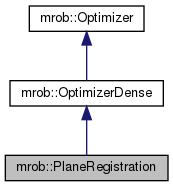
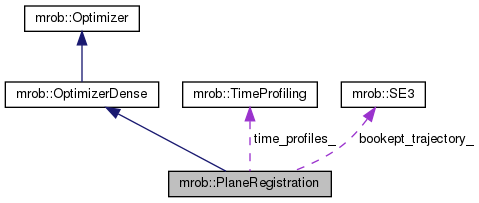
Public Types | |
| enum | TrajectoryMode { SEQUENCE =0, INTERPOLATION } |
| enum | SolveMode { INITIALIZE =0, GRADIENT, GRADIENT_BENGIOS_NAG, GRADIENT_ALL_POSES, GN_HESSIAN, GN_CLAMPED_HESSIAN, LM_SPHER, LM_ELLIP } |
 Public Types inherited from mrob::Optimizer Public Types inherited from mrob::Optimizer | |
| enum | optimMethod { NEWTON_RAPHSON =0, LEVENBERG_MARQUARDT_SPHER, LEVENBERG_MARQUARDT_ELLIP } |
Public Member Functions | |
| virtual matData_t | calculate_error () override |
| virtual void | calculate_gradient_hessian () override |
| virtual void | update_state () override |
| virtual void | bookkeep_state () override |
| virtual void | update_state_from_bookkeep () override |
| void | set_number_planes_and_poses (uint_t numPlanes, uint_t numPoses) |
| uint_t | get_number_planes () const |
| uint_t | get_number_poses () const |
| uint_t | solve (SolveMode mode, bool singleIteration=false) |
| uint_t | solve_interpolate_gradient (bool singleIteration=false) |
| uint_t | solve_gradient_all_poses (bool singleIteration=false) |
| uint_t | solve_initialize () |
| uint_t | solve_quaternion_plane () |
| void | reset_solution () |
| double | get_current_error () const |
| SE3 | get_pose (uint_t time) |
| std::vector< SE3 > & | get_trajectory () |
| SE3 | get_last_pose () |
| void | set_last_pose (SE3 &last) |
| void | add_plane (uint_t id, std::shared_ptr< Plane > &plane) |
| void | add_new_plane (uint_t id) |
| void | plane_push_back_point (uint_t id, uint_t t, Mat31 &point) |
| uint_t | calculate_total_number_points () |
| std::shared_ptr< Plane > & | get_plane (uint_t id) |
| std::unordered_map< uint_t, std::shared_ptr< Plane > > & | get_all_planes () |
| void | set_alpha_parameter (double alpha) |
| void | set_beta_parameter (double beta) |
| double | calculate_poses_rmse (std::vector< SE3 > &groundTruth) const |
| void | print (bool plotPlanes=true) const |
| std::vector< double > | print_evaluate () |
| void | add_point_cloud_planes (uint_t time, std::vector< Mat31 > &points, std::vector< uint_t > &point_ids) |
| std::vector< Mat31 > | get_point_cloud (uint_t time) |
| std::vector< Mat31 > | get_point_plane_ids (uint_t time) |
| Public Member Functions inherited from mrob::OptimizerDense | |
| OptimizerDense (matData_t solutionTolerance=1e-4, matData_t lambda=1e-5) | |
| Public Member Functions inherited from mrob::Optimizer | |
| Optimizer (matData_t solutionTolerance=1e-4, matData_t lambda=1e-5) | |
| uint_t | solve (optimMethod method, uint_t max_iters=1e2, double lambda=1e-5) |
Protected Attributes | |
| uint_t | numberPlanes_ |
| uint_t | numberPoses_ |
| uint_t | numberPoints_ |
| uint_t | isSolved_ |
| PlaneRegistration::TrajectoryMode | trajMode_ {} |
| uint_t | time_ {} |
| std::unordered_map< uint_t, std::shared_ptr< Plane > > | planes_ |
| std::shared_ptr< std::vector< SE3 > > | trajectory_ |
| std::vector< SE3 > | temporary_trajectory_ |
| SE3 | bookept_trajectory_ |
| double | tau_ {} |
| uint_t | solveIters_ {} |
| PlaneRegistration::SolveMode | solveMode_ |
| std::vector< Mat61 > | previousState_ |
| double | c1_ |
| double | c2_ |
| double | alpha_ |
| double | beta_ |
| Mat61 | gradient__ |
| Mat6 | hessian__ |
| TimeProfiling | time_profiles_ |
| double | initial_error_ {} |
| Protected Attributes inherited from mrob::OptimizerDense | |
| MatX | hessian_ |
| Protected Attributes inherited from mrob::Optimizer | |
| optimMethod | optimization_method_ {} |
| matData_t | solutionTolerance_ |
| uint_t | max_iters_ |
| MatX1 | gradient_ |
| MatX1 | dx_ |
| matData_t | lambda_ |
Additional Inherited Members | |
| Protected Member Functions inherited from mrob::OptimizerDense | |
| uint_t | optimize_newton_raphson_one_iteration (bool useLambda=false) |
| matData_t | calculate_model_fidelity (matData_t diff_error) |
| Protected Member Functions inherited from mrob::Optimizer | |
| uint_t | optimize_newton_raphson () |
| uint_t | optimize_levenberg_marquardt () |
Detailed Description
class PlaneRegistration introduced a class for the alignment of planes.
TO BE DEPRECATED
Member Function Documentation
◆ add_new_plane()
| void PlaneRegistration::add_new_plane | ( | uint_t | id | ) |
add new plane is an ALTERNATIVE (for py) to the above function which creates a new plane inside the class and then points are added one by one
◆ add_plane()
| void PlaneRegistration::add_plane | ( | uint_t | id, |
| std::shared_ptr< Plane > & | plane | ||
| ) |
add_plane adds a plane structure already initialized and filled with data
◆ add_point_cloud_planes()
| void mrob::PlaneRegistration::add_point_cloud_planes | ( | uint_t | time, |
| std::vector< Mat31 > & | points, | ||
| std::vector< uint_t > & | point_ids | ||
| ) |
add point_cloud requires a complete set of points observed at a given time stamp (XXX now only an integer) and fills in the registration structure.
◆ bookkeep_state()
|
overridevirtual |
For Levenberg-Marquard This function bookkeeps the current state values This is in case the optimization step does not improve
Implements mrob::Optimizer.
◆ calculate_error()
|
overridevirtual |
General abstract functions to implement: Calculate error calculates the current error function
Implements mrob::Optimizer.
◆ calculate_gradient_hessian()
|
overridevirtual |
Gradient calculates the gradient and Hessian This function may be called after calculate_error() or not (some cases of LM). For a general purpose it is required that this function is either: 1) self-contained. No assumptions made and recalculated (redundantly) residuals 2) Most of the times will be called after calculate_error. No recalculations are requires except inside the update_bookkeep_state which will have invalid residuals and need update (less prefered option)
Implements mrob::Optimizer.
◆ get_point_cloud()
| std::vector< Mat31 > PlaneRegistration::get_point_cloud | ( | uint_t | time | ) |
get_point_cloud gets all raw point, according to the current time index from trajectory. It does not distinguish between planes.
◆ get_pose()
◆ get_trajectory()
| std::vector< SE3 > & PlaneRegistration::get_trajectory | ( | ) |
Get trajectory returns a SE3 transformations,
◆ plane_push_back_point()
| void PlaneRegistration::plane_push_back_point | ( | uint_t | id, |
| uint_t | t, | ||
| Mat31 & | point | ||
| ) |
add a point to the new plane. An ALTERNATIVE (for py) to add points into the sover class (instead of adding the point fully as in add_plane())
◆ print_evaluate()
| std::vector< double > PlaneRegistration::print_evaluate | ( | ) |
print evaluate looks for degenerate cases, such as planes normal vectors, Hessian rank, det of all normals, etc. Basically this function tries to answer if the problem is ill-conditioned
Returns: 0) current error 1) number of iters, 2) determinant 3) number of negative eigenvalues 4) conditioning number
◆ reset_solution()
| void PlaneRegistration::reset_solution | ( | ) |
reset_solution, resets the current calculated solution while maintainting all data (planes) This function is intended for comparing different solvers without replicating data
◆ set_last_pose()
| void PlaneRegistration::set_last_pose | ( | SE3 & | last | ) |
Sets the trajectory (current solution) by addint the last pose
◆ solve()
| uint_t PlaneRegistration::solve | ( | SolveMode | mode, |
| bool | singleIteration = false |
||
| ) |
solve() calculates the poses on trajectory such that the minimization objective is met: J = sum (lamda_min_plane)
◆ solve_initialize()
| uint_t PlaneRegistration::solve_initialize | ( | ) |
solve_interpolate_hessian() calculates the poses on trajectory such that the minimization objective is met: J = sum (lamda_min_plane), and the trajectory is described as an interpolation from I to T_f using second order methods with Hessian. Very similar to solve_interpolate Initialization_solve give a first guess on all poses by using classical point-point methods SVD-based to calculate an initial condition closer to the true solution
◆ solve_interpolate_gradient()
| uint_t PlaneRegistration::solve_interpolate_gradient | ( | bool | singleIteration = false | ) |
solve_interpolate() calculates the poses on trajectory such that the minimization objective is met: J = sum (lamda_min_plane), and the trajectory is described as an interpolation from I to T_f
◆ solve_quaternion_plane()
| uint_t PlaneRegistration::solve_quaternion_plane | ( | ) |
Solve quaternion plane uses a paramteric representation for each plane, a quaternion, and optimizes both the plane parameters and the trajectory variables
◆ update_state()
|
overridevirtual |
Updates the current solution
Implements mrob::Optimizer.
◆ update_state_from_bookkeep()
|
overridevirtual |
For Levenberg-Marquard Undoes an incorrect update
Implements mrob::Optimizer.
The documentation for this class was generated from the following files:
- src/plane-surfaces/mrob/plane_registration.hpp
- src/plane-surfaces/plane_registration.cpp